
Pretend play in therapy is far more than make-believe – it’s a powerful way to build language, cognition, problem solving, and social understanding in children. For therapists and educators working with young learners, pretend play offers a natural and engaging way to support development across multiple domains. Whether children are pretending a banana is a phone or cooking soup in a toy pot, they are practicing the very skills that underpin communication, flexible thinking, and collaboration. Research has long shown that imaginative play supports language development, symbolic thinking, and social understanding, as children experiment with new vocabulary, narrative structures, and social roles while engaging in play.
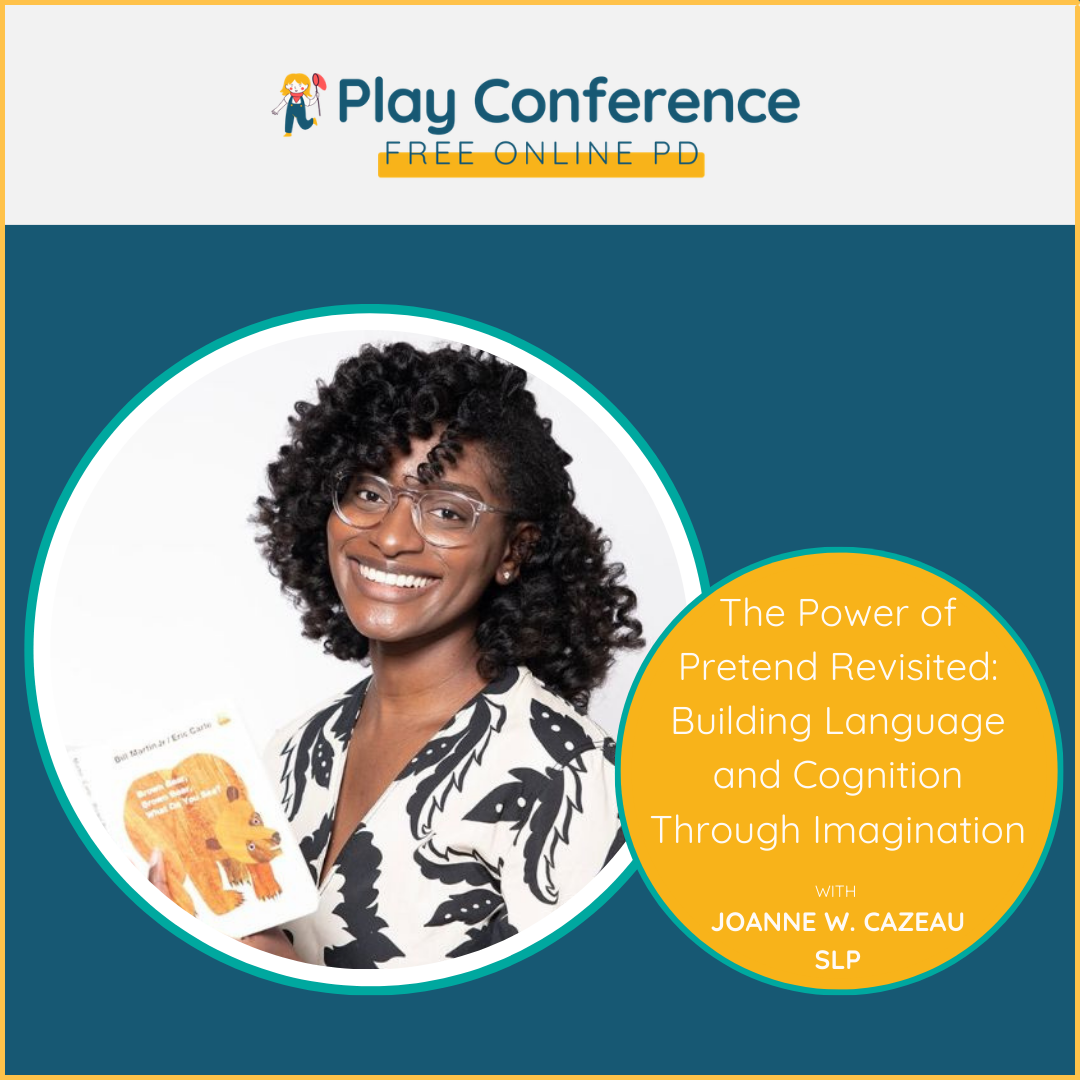
During her interview at the 2026 Play Conference, pediatric SLP Joanne Cazeau shared how clinicians can intentionally use pretend play in therapy to support diverse learners. In her practice, she focuses on child-led, play-based therapy where she doesn’t enter sessions with a rigid plan. Instead, she observes what the child is doing or gravitating toward and joins them there.
“I really feel like children learn best when it’s not like an adult-led agenda,” Joanne explains. “You just kind of find a way to support the goals and fit in the strategies.”
This approach highlights an important reminder for clinicians: therapy doesn’t always need to follow a tightly structured script. Sometimes the most effective intervention happens when we simply come alongside a child in play.
Pretend Play as a Whole-Brain Workout
Joanne describes pretend play as a “container for therapy.” Within that container, children are simultaneously practicing language, cognitive flexibility, and social understanding.
When children engage in pretend play, they are holding ideas in mind and assigning new meanings to objects. A banana becomes a phone, a spoon becomes a microphone, or a block becomes a piece of food in a pretend restaurant. This symbolic transformation requires children to think abstractly and flexibly – skills that are foundational for both language and problem solving.
Pretend play also involves planning sequences of events. A child might decide that first they will cook soup, then serve it to a friend, and finally clean up. These sequences mirror the structure of storytelling and everyday routines, allowing children to practice organizing events in meaningful ways.
Research on pretend play highlights that this symbolic transformation helps children develop flexible thinking and narrative abilities. Pretend play encourages children to explore ideas, practice storytelling, and experiment with language in flexible ways that support broader cognitive development.
How Pretend Play Supports Language Development
One of the most powerful aspects of pretend play is how naturally it encourages children to use language.
During imaginative play, children often use a wider variety of vocabulary than they might in structured tasks. They combine nouns, verbs, and descriptive words while narrating what is happening in the play scenario. Sometimes they even invent new words that fit the theme of the play, such as creating characters like a “rocket man” in a space adventure. These playful experiments with language show how children actively build meaning as they communicate.
Pretend play also encourages children to produce longer utterances. When describing what is happening in a play sequence, they begin combining words and linking ideas together. Talking about what happens first, what comes next, and what happens at the end helps children expand their sentences and develop early narrative skills.
Another important element is cause and effect. Within a play story, events happen for a reason: the pizza is hot because it came out of the oven, or the baby is crying because it is hungry. Talking through these connections helps children build reasoning and communication skills simultaneously.
As Joanne explains, pretend play essentially gives children a reason to say more – and to say it in connected ways that make sense within a story.
Pretend Play, Cognitive Flexibility, and Social Understanding
Pretend play challenges children to think flexibly while also navigating social interactions. Objects can take on new roles, characters can change positions, and the storyline can shift direction at any moment.
A child might begin as the doctor while the adult is the patient. A few moments later, those roles might switch. The story may also change when an unexpected problem appears – perhaps the baby starts crying, the food burns, or the tower falls down. In these moments, children need to adjust their thinking, adapt the storyline, and respond to the ideas or reactions of their play partner.
These shifts build executive functioning skills, including:
- Flexible thinking
- Planning and sequencing
- Adaptability when plans change
At the same time, shared pretend play helps children practice perspective taking as they consider another person’s ideas, emotions, and intentions within the play scenario.
Pretend play also requires children to share control of the narrative. Both participants contribute ideas, negotiate changes, and work together toward a shared goal, whether they are building a tower, preparing a meal, or completing a rescue mission.
Through these interactions, children develop empathy, cooperation, and the social flexibility needed for peer interactions and group participation. Pretend play creates a safe space where they can experiment with ideas, revise plans, and learn how to respond when things don’t go exactly as expected.
Supporting Diverse Learners in Pretend Play
It is important to remember that pretend play is not a one-size-fits-all activity. Children may engage in imaginative play in different ways depending on their communication style, developmental stage, and sensory preferences.
Some children may express pretend play primarily through actions rather than words, particularly if they are language delayed or communicate through alternative modalities. Others may need additional scaffolding to understand how to enter a play scenario.
Clinicians can support participation by modeling play actions, repeating play routines, and simplifying language. Visual supports can also help children understand the sequence of events in a pretend play activity – for example, showing the steps involved in cooking a pretend meal or completing a construction project.
For children who use AAC, pretend play provides rich opportunities for communication. Devices, picture supports, sign language, and written language can all be integrated into play scenarios. Modeling core words such as go, stop, help, want, more, and turn within play helps children learn how language connects to real interactions.
Sensory preferences are also important to consider. Some children may need time to explore materials gradually before engaging fully in a play scenario. Respecting sensory boundaries helps ensure play remains safe and enjoyable.
Cultural context also matters. Families may have different expectations about play roles or activities, and open communication with caregivers helps ensure therapy remains respectful and meaningful for each child.

Using Pretend Play Across Therapy Disciplines
Pretend play is not just valuable for speech-language pathologists. Occupational therapists, physical therapists, educators, and other clinicians can all integrate imaginative play into their sessions.
Within a single play scenario, children can practice communication, language structures, participation skills, and problem solving. A pretend cooking activity, for example, might involve requesting ingredients, describing actions, taking turns, answering questions, and sequencing steps.
Pretend play also creates natural opportunities to practice waiting, transitioning between tasks, and adapting when plans change. These participation skills are often essential for success in classroom and group environments.
Creating Opportunities for Problem Solving
One of the most valuable aspects of pretend play is that it allows clinicians to introduce small, manageable challenges.
A therapist might intentionally create a small problem in the play scenario – perhaps a tool is missing, a structure collapses, or something doesn’t work the way it should. Instead of immediately fixing the issue, the adult can guide the child to notice the problem and explore possible solutions.
These moments help children develop persistence, flexible thinking, and confidence as they learn that problems can be solved in multiple ways.
Pretend Play Doesn’t Require Special Toys
Another common misconception that Joanne brings up, is the idea that pretend play requires elaborate toy sets or specific materials. In reality, imaginative play can emerge from almost anything.
Everyday objects often spark the most creative play – water bottles, utensils or even a bin that might transform into a swimming pool. What matters most is not the toy itself, but the child’s ability to assign meaning and create a story around it.
The Power of Child-Led Play
Perhaps the greatest strength of pretend play is that it shifts the dynamic between adult and child. Instead of the adult directing every step, children have the opportunity to lead. They decide what the story will be, what roles everyone plays, and how the interaction unfolds.
This sense of agency can be incredibly motivating. When children feel that their ideas matter, they become more engaged, more communicative, and more willing to explore new possibilities within play.
And sometimes, play simply takes unexpected directions – and that’s perfectly okay.
This is just a glimpse: watch the full interview plus 15 other expert-led talks from the 2026 Play Conference – The Experience Gap: Are Our Kids Experiencing the World or Just Watching It?
About Joanne W. Cazeau
Joanne is a pediatric SLP, play enthusiast, and lover of all things early language. She helps little ones find their voice and supports parents in feeling confident along the way. She is the owner of Koze Speech Therapy, her New Jersey private practice, and the creator of Beyond Babbles, where she shares simple, supportive strategies that make early communication feel lighter for families and providers.