Social groups are often recommended as a key support for neurodivergent students in inclusive and integrated school settings. Yet many therapists and educators find themselves questioning whether traditional social skills groups truly meet the needs of the children they serve. What does a “social group” actually mean for a child with ADHD or autism? How can these groups be meaningful rather than performative? And in some cases, could conventional approaches unintentionally do more harm than good?
According to Speech-Language Pathologist Jency Chacko, M.S., CCC-SLP, the answer lies in shifting our perspective. Rather than trying to fix or normalize children, neurodiversity-affirming social groups focus on connection, accessibility, agency, and belonging.
Rethinking Social Groups: From Fixing to Supporting
Traditional social skills frameworks often emphasize outward behaviors such as eye contact, scripted greetings or “expected” responses. While well-intentioned, these approaches can unintentionally push children toward masking and reinforce neurotypical norms as the standard.
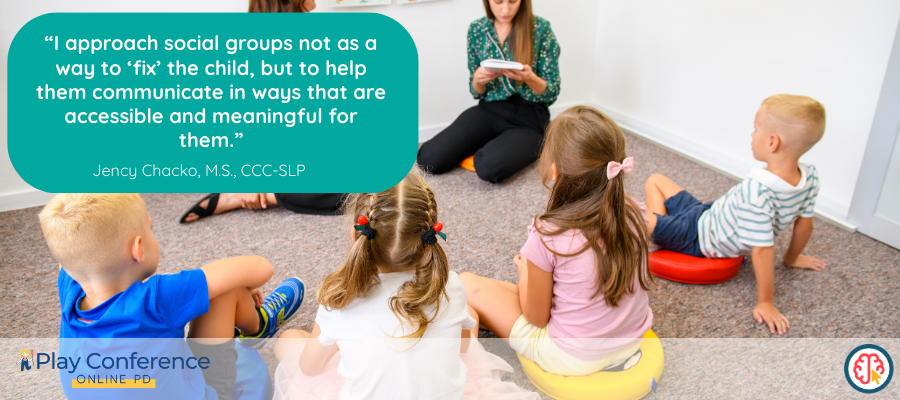
Jency approaches social groups differently, by trying to give them accessible ways to communicate that are meaningful to them.
This begins with asking children directly:
- What do you enjoy?
- What feels hard?
- What do you want support with?
By valuing children’s lived experiences and perspectives, social groups become collaborative spaces where strengths are recognized alongside challenges.
Making Social Groups Neurodiversity-Affirming
Prioritizing Receptive Skills Over Performance
One of the most meaningful shifts Jency makes in her social groups is prioritizing receptive social understanding over outward performance. Rather than focusing on how a child should say something or what their behavior should look like, she begins with what the child is understanding.
Receptive goals might include:
- Understanding communication breakdowns
- Recognizing different communication styles
- Perspective-taking
- Problem-solving and inference
- Understanding how others may think or feel differently
When social learning focuses too heavily on expressive goals, it often reinforces neurotypical norms and increases pressure to mask. When expressive support is needed, it is always collaborative. Children are invited to decide how they want to communicate, whether they want help, or if a script would feel supportive in that moment. The goal is not compliance, but agency. Rather than being told what to say, children are empowered to decide what feels right for them, preserving autonomy and self-trust.
Sensory Regulation as a Pathway to Connection
Social connection does not exist in isolation from regulation, and Jency places a strong emphasis on understanding each child’s sensory preferences. Importantly, sensory preferences are not used only as regulation tools. Jency actively incorporates them into social connection. When children discover shared sensory experiences – such as enjoying movement, deep pressure, or quiet parallel play – those preferences can become a natural bridge between peers. In this way, regulation supports are transformed into opportunities for shared engagement rather than something that separates a child from the group.
Special Interests as Strengths, Not Distractions
Special interests are a central and celebrated part of Jency’s social groups. Rather than viewing them as distractions that need redirection, she treats them as powerful tools for confidence and connection.
Whenever possible, children are asked directly about what they enjoy and feel knowledgeable about. When a child is unable to articulate this themselves, families provide valuable insight. These interests are then intentionally woven into group activities, allowing children to experience themselves as competent and valued contributors.
When children are encouraged to share their knowledge – whether about Lego builds, Minecraft worlds, dinosaurs, or another passion – they often engage more fully and confidently. This approach sends a clear message: there is nothing inherently “wrong” with them. Instead of entering social groups with the belief that they need to be fixed, children begin to see themselves as experts with something meaningful to offer.
Balancing Structure and Flexibility
Jency’s social groups intentionally include both structured and unstructured time:
- Unstructured time allows for free play, parallel play, and child-led interaction
- Structured activities target goals children have identified as meaningful or challenging
- Decompression time at the end supports regulation and autonomy
This balance ensures children aren’t over-directed, while still benefiting from guided support.
Supporting Different Ages and Developmental Stages
Children’s awareness and agency vary widely, so conversations are adapted accordingly. With younger children, discussions may focus on playdates, friendships, and everyday experiences. With older children, conversations expand to include school routines, peer dynamics, and social challenges.
As children grow, Jency intentionally increases their agency while continuing to gather essential insights from families, ensuring support remains developmentally appropriate and collaborative.
Building Friendships Through Shared Understanding
Drawing inspiration from Dr. Barry Prizant, a leading voice in neurodiversity-affirming practice, Jency emphasizes that friendship support should feel affirming rather than corrective. Instead of teaching children how they should behave in social situations, her approach focuses on building shared understanding, flexibility, and mutual respect.
Interest-based activities help children experience themselves as capable and valued participants. Self-advocacy is also prioritized, with children supported in identifying their needs, recognizing discomfort, and communicating boundaries in ways that feel authentic. Perspective-taking is introduced as a receptive skill, supporting understanding without requiring children to suppress their own experience.
When challenges arise, children are guided through collaborative problem-solving. Questions like, “If this didn’t work, what else could we try?” invite curiosity rather than judgment. Visualization and pre-experiencing further support children in preparing for social situations by reducing uncertainty and cognitive load.
Over time, children learn that friendships are built through shared responsibility. They begin to understand that multiple perspectives can coexist, that compromise belongs to everyone involved, and that adults and peers can be supportive partners in navigating social challenges.
Emotional Awareness, Interoception, and Self-Advocacy
Emotional awareness is woven throughout Jency’s social groups, with a strong emphasis on interoception – which is the ability to notice and interpret internal body signals, such as hunger, heart rate, muscle tension, temperature, and the physical sensations that often come before big emotions. Rather than relying on abstract questions like “How do you feel?”, Jency uses concrete, body-based language to help children identify emotional states. Children might be asked whether their face feels warm, their stomach feels tight, or their body feels jumpy or heavy.
This approach allows children to recognize emotional escalation earlier, before it becomes overwhelming. From there, support becomes collaborative. Children co-create self-advocacy phrases, select regulation strategies that feel effective, and develop problem-solving plans they can use across settings. Peers often contribute as well, sometimes noticing changes the child has not yet recognized themselves, reinforcing shared awareness and connection.
Video Modeling That Respects Individual Differences
Video modeling is another powerful tool, particularly when it avoids rigid or scripted expectations. Instead of presenting a single “right way” to behave, video is used to explore the many ways people communicate and interact.
Through these examples, children are invited to notice different perspectives, observe varied communication styles, and reflect on what feels comfortable or familiar to them. This contextual learning often resonates more deeply than traditional role-play alone, offering insight without pressure to perform or imitate.
Masking, Unmasking, and Social Energy
With older children who understand their diagnosis, Jency suggests to introduce thoughtful conversations around masking and unmasking. Together, therapist and child can explore which environments require greater social effort and which allow for authenticity and rest.
Children learn to identify settings where masking feels necessary, plan for intentional unmasking and recovery time, and use energy check-ins to gauge their social capacity. These conversations support long-term emotional wellbeing by helping children understand their limits, advocate for their needs, and avoid chronic social burnout.
What is the ideal size and duration for group sessions?
The structure of social groups plays an important role in their success. In an ideal setting, Jency recommends keeping groups small – often around three children – to allow for deeper connection and individualized facilitation. Groups typically run in shorter cycles of approximately six weeks, with breaks between cycles to allow learning to settle and generalize.
This format reduces overwhelm, supports meaningful carryover at home and school, and creates space for reflection and growth. While sessions are guided by clear goals, planning remains intentionally flexible and responsive to what emerges organically within the group.
Social Executive Function: Supporting Connection at the Cognitive Level
Rather than framing friendship challenges as social skill deficits, Jency emphasizes the role of social executive functioning. Skills such as working memory, inhibition, cognitive flexibility, planning, and initiation are foundational to navigating social spaces. When these systems are taxed, social interaction becomes more difficult regardless of a child’s motivation to connect.
To support these processes, Jency incorporates visual plans, shared schedules, and mental anchors – physical objects, drawings, or written reminders that help children hold onto ideas and return to conversational threads. By offloading cognitive demands, children are better able to stay present and engaged with peers.
These supports do not tell children how to behave. Instead, they give the brain what it needs to participate in connection without relying on masking or memorized rules. The result is increased engagement, reduced fatigue, and more authentic, sustainable relationships.
Creating Spaces Where Children Belong
At their best, neurodiversity-affirming social groups honor each child’s communication style, reduce the need for masking, and support genuine connection. They build confidence, agency, and a sense of belonging that extends beyond the group itself.
When children are supported as whole human beings – rather than projects to fix – social groups become places where they can truly thrive.
This is just a glimpse: get the full interview plus 13 other expert-led talks on mastering push-in therapy in schools.
About Jency Chacko
Jency has a niche practice (Playhouse Speech Therapy) where she primarily works with ADHD and Autistic children. She also has a separate business (Vivid Embers) where she provides consulting, workshops, and resources that empower families and therapists to help neurodivergent children foster confidence in communication, independence, and meaningful relationships – helping every child thrive in their own unique way.
Vivid Embers Website: https://www.vivid-embers.com/
Playhouse Speech Therapy Website: https://www.playhousespeechtherapy.com/