
In today’s digital childhood, many children are experiencing what researchers call “experience poverty.” When children move, explore, play, and interact with others, they build the neural pathways that support language, regulation, motor skills, and social understanding. Yet many clinicians, educators, and families are noticing something different about modern childhood. Children are often busy, supervised, and constantly stimulated – but they may still lack access to the everyday experiences that historically supported development.
Understanding this shift requires examining development through both a developmental and occupational lens.
What Is Experience Poverty?
Traditional discussions of child development often focus on deficits or diagnoses. But development is shaped as much by opportunity for experience as by innate ability.
In occupational science, the related concept of occupational deprivation describes when people are prevented from participating in meaningful daily activities – not by choice, but due to environmental factors.
For children, these daily “occupations” include:
- Play
- Exploration
- Physical movement
- Social participation
- Rest
- Predictable routines
These are not optional enrichment activities – they are the foundation of development.
Experience poverty arises when children have limited access to these foundational experiences. It is rarely the result of neglect; instead, broader systems, schedules, safety concerns, and modern lifestyles often restrict opportunities – even in well-resourced families.
Why Experience Matters for Development
Early childhood research consistently links reduced access to play, interaction, and movement-rich environments with differences in:
- Self-regulation
- Language development
- Executive function
- Stress physiology
Children adapt to the environments they experience. When opportunities for exploration, social interaction, and self-directed play are limited, development adjusts to those constraints, affecting curiosity, resilience, and sustained attention.

A Historical Example of Experience Deprivation
One of the earliest demonstrations of how environment shapes development came from the work of psychoanalyst René Spitz in the 1940s, where he studied two groups of infants:
- Babies raised in a foundling home
- Babies whose mothers were imprisoned but who lived in a prison nursery with daily maternal contact
Both groups had their basic physical needs met. They received adequate nutrition and hygiene. However, their environments differed dramatically.
In the foundling home:
- Infants spent most of the day alone in cots
- Curtains surrounded the beds to prevent infection
- Adult contact was limited to brief feedings and diaper changes
- Social interaction and stimulation were minimal
In the prison nursery:
- Infants had daily interaction with their mothers
- They experienced relational contact and engagement
The developmental outcomes were striking.
The children who experienced regular maternal interaction showed normal developmental progress. Those in the foundling home showed profound delays in physical, emotional, and cognitive development. Many were unable to walk by age three and were described as withdrawn and apathetic. Their physical survival needs had been met but their relational and experiential needs had not.
This work helped establish a critical principle that decades of research have since reinforced: Human development depends on lived experience – not just survival.
Children’s brains are literally shaped by daily experiences. Each time a child moves, explores, connects socially, or engages in play, neural pathways are strengthened, helping them understand the world and their place within it.
New skills – whether in emotional regulation, communication, or coordination – emerge through repeated practice and meaningful engagement. When these experiences are restricted, the brain adapts to what is available. This adaptation is at the heart of experience poverty.
Importantly, this is not limited to under-resourced environments. Even children with access to education, technology, and material resources may have fewer opportunities for self-directed, real-world exploration, which limits experiences that develop agency, problem-solving, and autonomy.
The developmental outcomes were striking.
The children who experienced regular maternal interaction showed normal developmental progress. Those in the foundling home showed profound delays in physical, emotional, and cognitive development. Many were unable to walk by age three and were described as withdrawn and apathetic. Their physical survival needs had been met but their relational and experiential needs had not.
This work helped establish a critical principle that decades of research have since reinforced: Human development depends on lived experience – not just survival.
Children’s brains are literally shaped by daily experiences. Each time a child moves, explores, connects socially, or engages in play, neural pathways are strengthened, helping them understand the world and their place within it.
New skills – whether in emotional regulation, communication, or coordination – emerge through repeated practice and meaningful engagement. When these experiences are restricted, the brain adapts to what is available. This adaptation is at the heart of experience poverty.
Importantly, this is not limited to under-resourced environments. Even children with access to education, technology, and material resources may have fewer opportunities for self-directed, real-world exploration, which limits experiences that develop agency, problem-solving, and autonomy.
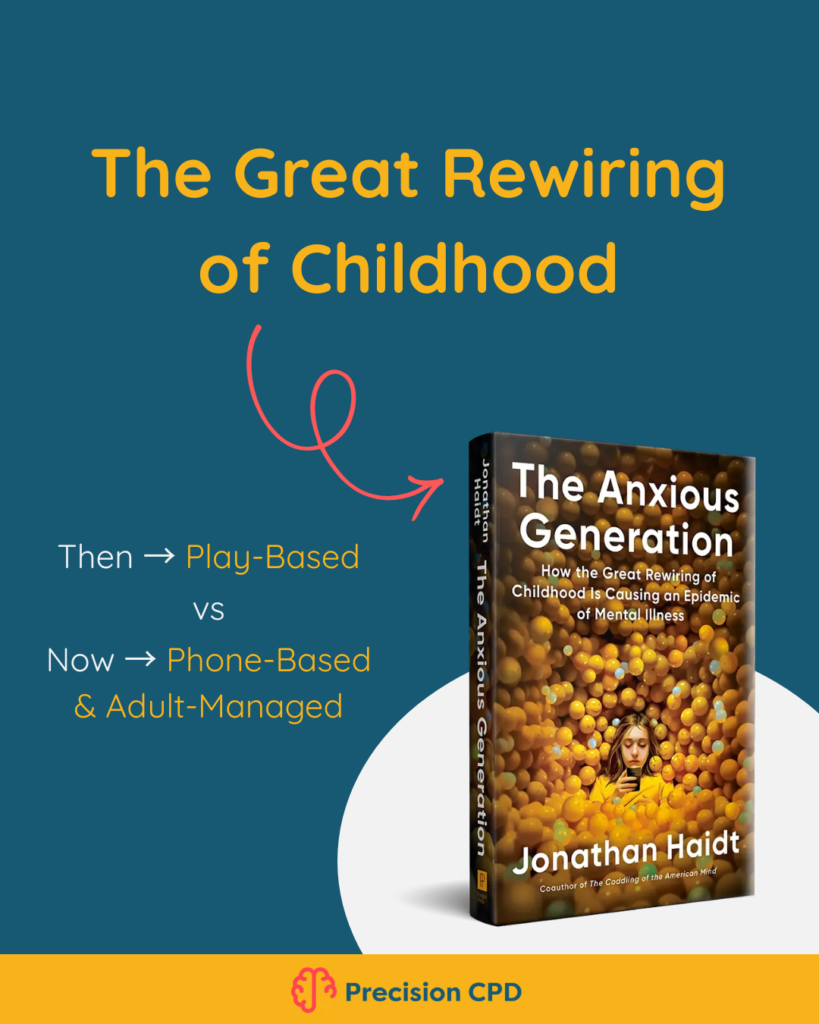
The Digital Childhood and “The Great Rewiring”
In his book The Anxious Generation, social psychologist Jonathan Haidt describes a phenomenon he calls the “great rewiring of childhood.”
Haidt emphasizes that children are not inherently changing; rather, the conditions of childhood are shifting rapidly, exposing most children to experience poverty and occupational deprivation – regardless of socioeconomic background.
According to Haidt, childhood environments have undergone two major shifts.
1. From Play-Based to Phone-Based Childhood
For most of human history, childhood was largely:
- Play-based
- Movement-rich
- Social and peer-driven
- Outdoor and exploratory
Children spent hours each day in unstructured play, navigating social dynamics and solving problems independently.
Around 2010, however, childhood began shifting toward a screen-centered environment. Experiences moved indoors, onto digital devices, and away from embodied, real-world interactions.
This shift has changed the types of experiences shaping children’s nervous systems. Instead of sustained, self-directed engagement, many children now experience rapid novelty, constant external stimulation, and predictable reward cycles.
Children adapt to these environments – but they adapt to different developmental inputs.
2. From Child-Directed to Adult-Managed Childhood
At the same time that screens became central to childhood, another shift occurred: childhood became increasingly adult-managed.
Driven by understandable concerns about safety, achievement, and success, adults began to:
- Closely supervise play
- Schedule children’s time
- Reduce unsupervised peer interaction
- Eliminate risk and discomfort
While these changes are often well-intentioned, they also reduce opportunities for self-initiation – a developmental skill that grows when children can initiate actions, explore independently, take risks, and solve problems on their own.
When childhood becomes highly managed, this skill does not disappear. Instead, it simply remains underdeveloped due to limited opportunity to practise.
Four Developmental Risks of a Screen-Based Childhood
So what does “rewiring” actually mean?
From the perspective of Jonathan Haidt, rewiring refers to a neurodevelopmental adaptation. Children’s brains organise themselves around the experiences that are repeated most often.
In highly managed, screen-heavy environments, children develop:
- External regulation rather than internal regulation
- Attention for short bursts rather than sustained focus
- Avoidance of discomfort rather than persistence
This is not a pathology. It is the nervous system learning from the environment it is exposed to.
Within this context, Haidt describes four developmental risks that are increasingly visible in modern childhood.:
- Social Deprivation: Fewer opportunities to practice turn-taking, flexibility, conflict resolution, and peer negotiation. Clinically, this may appear as rigid social scripts or low frustration tolerance.
- Sleep Deprivation: Evening screen exposure and busy schedules disrupt sleep, impairing memory, emotional regulation, and sensory processing.
- Attention Fragmentation: Rapid stimulus switching in digital environments reduces sustained attention, effortful problem-solving, and tolerance for slower-paced tasks.
- Dopamine Dysregulation & Reduced Motivation: High-reward, low-effort digital experiences limit persistence, intrinsic motivation, and self-initiated exploration.
Clinically, this can appear as resistance to effortful play, reduced tolerance for challenge, or difficulty transitioning away from preferred digital activities.
Importantly, Haidt emphasizes that children are not broken. They are adapting exactly as nervous systems do when environments change.
This helps explain why many therapists and educators feel that development looks different today. Therapy can feel slower, more foundational, and more complex – not because children are less capable, but because therapy is now rebuilding experiences that once occurred naturally through daily play and exploration.

Rethinking the Clinical Question
Historically, when a child struggled with a skill, the clinical question was often: “What skill is missing?”
In the context of modern digital childhood, a more useful question may be: “What experiences were available for this child to build that skill?”
Many developmental frameworks were built on assumptions that children had daily access to:
- Peer play
- Outdoor exploration
- Physical movement
- Sustained imaginative play
Modern environments often do not provide these conditions. As a result, clinicians are increasingly working not only on skills – but on rebuilding the experiences that support those skills. Across several developmental domains, we can see how changes in everyday experience influence the skills children bring into therapy:
➜ Social Play
- Historically: hours of peer-led, outdoor, unstructured play (Parten, 1932).
- Today: average 4–7 minutes of free outdoor play daily, often replaced by screens or scheduled activity.
➜ Movement Exposure
- Historically: movement embedded in daily life.
- Today: many children spend most waking hours sedentary, despite recommendations for 3+ hours of daily movement. Therapy often rebuilds foundational motor experiences.
➜ Attention & Executive Function
- Historically: longer stretches of self-directed play fostered sustained attention and problem-solving.
- Today: frequent transitions, high screen exposure, and rapid stimulus switching require clinicians to distinguish developmental capacity vs. environmental mismatch.
➜ Sleep
- Roughly one-third of children experience insufficient sleep, which affects learning, regulation, and sensory processing.
- Supporting sleep includes hygiene, movement routines, sensory regulation, and co-regulation strategies.
➜ Sensory Experience
- The Sensory Integration framework links sensory processing to function, learning, and participation. It assumes children have regular access to vestibular, proprioceptive, and tactile input throughout daily life.
- Modern childhood often limits these experiences while increasing visual and auditory stimulation from screens. Clinicians must consider sensory nutrition—what is missing, excessive, or lacking in variety.
Across all these developmental domains, a consistent pattern emerges: traditional developmental frameworks were built on assumptions of experience-rich childhoods. Modern childhood often does not meet these assumptions. When therapy feels slower, more foundational, or more complex than expected, it is not because children are less capable or development is broken – it is because therapy is increasingly rebuilding experiences that once occurred naturally through daily life and play.
Rebuilding Experience in Childhood
While individual therapy alone cannot reverse large-scale societal changes, professionals working with children can play a meaningful role in restoring experience-rich environments.
Three key approaches are emerging across disciplines:
- Lifestyle Advocacy for Play: Promote free play, outdoor exploration, movement-rich routines, and reduced screen exposure.
- Experience-Driven Play-Based Therapy: Use play to practise self-initiation, problem-solving, regulation, and social interaction.
- Equity in Developmental Experiences: Advocate for environments where all children have access to experiences that support healthy development.
Multidisciplinary teams, including therapists, educators, and health professionals, are essential in creating environments where all children can access experiences that support healthy development. Today’s childhood comes with unique challenges, but understanding experience poverty helps us see that children are not broken; their development reflects the opportunities and limitations they encounter.
By prioritizing experience-rich environments, both in therapy and at home, we can help children build the foundational skills that foster curiosity, resilience, social-emotional growth, and a lifelong love of learning.
This is just a glimpse: watch the full interview plus 15 other expert-led talks from the 2026 Play Conference – The Experience Gap: Are Our Kids Experiencing the World or Just Watching It?
About Holly Peretz
Holly Peretz is a Pediatric Occupational Therapist with 14+ years of experience working with children and parents as a therapist and parent educator within hospitals, NGO’s preschools, hydrotherapy, and online. Through her work at Precision CPD she aims to better the services provided to children through quality professional development events, content, and courses for professionals working with children.